

Shady
−1
The case did not persuade the Juror, and the action still feels wrong or unacceptable.
Draw a Scenario → Make Your Case → Defend Your Position → Face the Verdict.
Will the action be judged Shady, Undecided, or Justified?
Every turn follows the same rhythm: Draw a Scenario → Make Your Case → Defend Your Position → Face the Verdict.
The Advocate draws a card describing a morally questionable action.
The Advocate explains why the action could be justified.
Each Juror may ask one independent question or pass. The Advocate responds before the vote.
Jurors privately choose Shady, Undecided, or Justified, then reveal their voting tokens together. Only the Advocate's score changes.
“While leaving a restaurant, you took a server's tip from another table.”
Jurors are not grading a single correct answer. Each vote reflects how convincing the Advocate's case was at the table.
Shady is −1, Undecided is 0, and Justified is +1. Only the Advocate's score changes on each turn.
Each Juror privately selects Shady, Undecided, or Justified. Once everyone is ready, all tokens are revealed together. Add the values to determine the Advocate's score change. The Advocate does not vote on their own turn.
−1
The case did not persuade the Juror, and the action still feels wrong or unacceptable.

0
The Advocate raised reasonable points, but the Juror remains unconvinced either way.

+1
The Advocate made a convincing case. The Juror accepts the position as reasonable.
Every player begins at 0 on a personal Moral Compass track from −10 to +10. Scores remain capped within that range.
Choose Fixed Rounds or Elimination before play. Fixed Rounds supports 1–10 rounds, with four as the default, and the highest score at the end wins. In Elimination, players place in the order they reach +10; once placed, they leave the Advocate rotation but continue asking questions and voting as Jurors. The final remaining player loses. Final Fixed Rounds ties are resolved through additional Advocate turns among the tied players.
500 unique Scenario Cards
Divided evenly across four categories: 125 Everyday Choices, 125 Family Matters, 125 Friends & Social Circles, and 125 Digital Life.
Together, the four categories form one Core Deck.
Future expansions may revisit these subjects with at least 200 entirely new scenarios.
Restaurants, stores, neighbors, favors, public behavior, found property, small lies, etiquette, and everyday hypocrisy.
Siblings, parents, grandparents, chores, privacy, favoritism, traditions, obligations, family money, and loyalty.
Loyalty, secrets, gossip, exclusion, peer pressure, reputation, friendship breakups, bullying, retaliation, and choosing sides.
Social media, gaming, screenshots, passwords, tracking, AI, deepfakes, piracy, misinformation, online harassment, and digital privacy.
Moral Compass is a social justification and judgment game—not trivia and not a morality test with one right answer. Players argue, question, and vote on whether the Advocate's position holds up.
One Advocate makes a case for the scenario. Jurors listen, ask one question each, and select voting tokens privately. Each Juror decides what counts as convincing—and that changes every round.
Core Deck: Ages 8+ · 2–10 players · Recommended 3–8 players
The Core Game is designed for face-to-face play with reusable components that carry across every session—separate from the Scenario Card collection itself.
The Core Deck—125 cards per category across Everyday Choices, Family Matters, Friends & Social Circles, and Digital Life. One clear scenario per card.
Ten each for Shady, Undecided, and Justified—enough for every player to choose privately and reveal together.
Gives the Advocate up to 60 seconds to make the initial case. Juror questions follow.
Track each player from −10 to +10 across the session—separate from voting tokens.
Place on Player Score Trackers to show each player's current score—not used for casting votes.
Clear setup, turn, scoring, game mode, and tie-breaker instructions.
Explore planned expansions built around different themes, audiences, and levels of intensity.
Each standard expansion is planned to contain at least 200 unique Scenario Cards. Expansions may deepen subjects found in the Core Deck, but Core scenarios are never repeated or lightly rewritten.
Age guidance varies by expansion. Working titles and release order may change.
More complicated public behavior, social obligations, ethical shortcuts, competing courtesies, and everyday decisions with consequences that are harder to dismiss.
Deeper conflicts involving loyalty, inheritance, caregiving, long-held secrets, financial obligations, estrangement, and competing family responsibilities.
Homework, cheating, teachers, classmates, bullying, discipline, popularity, teams, clubs, and school authority.
More complex conflicts involving sustained bullying, social hierarchy, manipulation, retaliation, reputational harm, group loyalty, and intervention.
Deeper questions involving surveillance, identity, artificial intelligence, permanent records, online influence, manipulation, consent, and digital power.
Dating, trust, jealousy, ex-partners, flirting, boundaries, commitment, shared finances, breakups, and romantic expectations.
Coworkers, bosses, customers, credit, schedules, company property, expenses, hiring, promotions, office politics, and questionable instructions.
Wealth, debt, tipping, influence, status, negotiation, charity, inheritance, competition, exploitation, and personal ambition.
Safety, loyalty, justice, sacrifice, public welfare, punishment, compassion, scarce resources, competing harms, and impossible choices.
Discipline, monitoring, school decisions, rewards, sibling fairness, autonomy, social media, protection, and difficult parenting choices.
Flirtation, temptation, jealousy, secrecy, trust, adult dating, and the choices people make when good judgment goes to bed early.
Explicit, vulgar, professionally inappropriate, and socially unacceptable adult scenarios that push players to defend the nearly indefensible.
Can't gather around the same table? A Discord version is in development for remote play and community playtesting.

Draw a Scenario → Make Your Case → Defend Your Position → Face the Verdict.
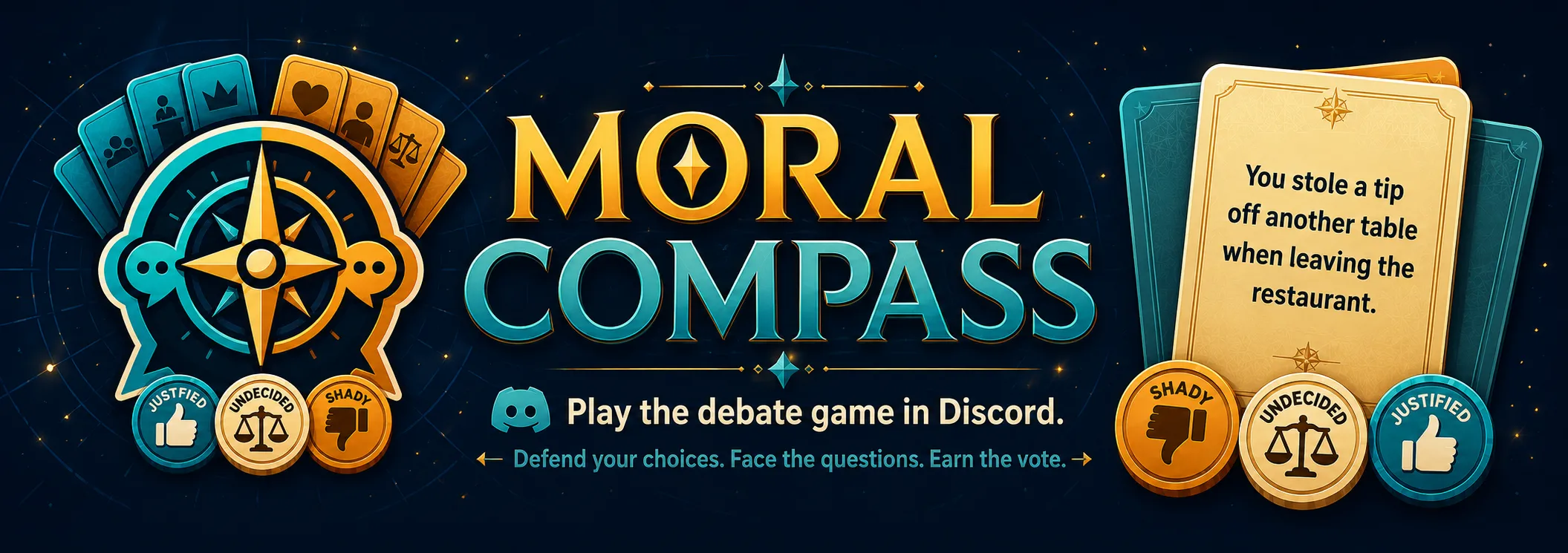
Moral Compass is preparing for crowdfunding with a Core Game featuring 500 unique Scenario Cards and a long-term lineup of themed expansions.
Final launch configuration, add-ons, and release sequencing will be announced with the campaign.
(Frequently Avoided Questions)
No. But we'd like to remind everyone that Undecided was always an option.
Possibly. Their new understanding of you is permanent.
A little. You can also be impressed. Both feelings are valid.
Yes. Friendship and consistency are sold separately.
You can argue with anything. That doesn't mean it'll help.
Congratulations. You've recreated a committee meeting.
You can try. We're not responsible for what happens when the sand runs out.
It might save both of you a lot of time.
We admire your optimism.
Thanksgiving was doing fine on its own.
Looking for actual rules or product details? Everything important is explained above.